| Chapter 3 | Future with voy, vas, va, vamos, and van
You’ve learned that the preterit past FUI, FUISTE, FUE, FUIMOS, and FUERON has its imperfect past partner IBA, IBAS, IBA, ÍBAMOS, IBAN . By definition, the preterit reports a specific point in time while the imperfect describes a habitual or ongoing action. |
| She is going to give me it | Ella va a dármela. |
| Did you go buy it? | ¿FUE a comprarla? |
| Are you going to call her? (familiar) | ¿Vas a llamarla? |
| I went to exchange the money | FUI a convertir/cambiar el dinero. |
| I went to the beach | Yo FUI a la playa. |
| I used to go to the beach | Yo iba a la playa |
| We would go | Nosotros iríamos. |
| Get out of here | ¡Vete! |
| Where are you going? | ¿A dónde vas/va? |
| They went downtown | Fueron al centro |
| They are going to see me Wednesday. | Van a verme el miércoles |
| I was going downtown when | Iba al centro cuando |
| Chapter 4 | yo ayudaré, tu ayudarás, el/ella ayudará, nosotros ayudarémos, ellos/ellas ayudarán – yo and nosostros (includes speaker) uses é, otherwise á, You’ll want to use Recipe 8 when describing events that are not too far into the future : Mis amigos comen esta noche. |
| Will you eat with us | comes con nosotros (recipe 8, near future) |
| Will you close the door | Cierras la puerta (recipe 8, near future) |
| I will see Marta tomorrow (recipe 11) | Yo veré a Marta manana |
| Will you speak with her | Hablarás con ella |
| We will eat here Friday | comeremos aqui el viernes |
| Where will you go | ¿A dónde irás? |
| What time do you wake up (familiar) | ¿A qué hora te despertarás? |
| They will live in Mexico | Ellas vivirán en México. |
| She will walk | Ella caminará. |
| Will you work Saturday | Trabajará el sabado |
| Will they see us | Nos verán |
| I’ll invite her | La invitaré |
| I’ll speak with her | Hablaré con ella |
| We’ll show him the gift next week | Le mostraremos el regalo la semana próxima. // the gift to him is le |
| I will be a teacher | Yo seré maestra |
| What will you be (familiar) | ¿Qué serás? |
| It will be one | Será la una. |
| It will be five | Serán las cinco. |
| It’ll be 3:30 when you arrive tomorrow. Is it possible to arrive earlier? | Serán las tres y media cuando llegas mañana. ¿Es posible llegar más temprano? |
| Recipe 11 can describe the conjectural present. | |
| I wonder if it’s Lupe. | ¿Será Lupe? |
| I wonder if it’s them. | ¿Serán ellos? |
| I wonder what she’s buying. | ¿Qué comprará ella? |
| I wonder how much it costs. | ¿Cuánto costará? |
| like this little thing here. I wonder how much it costs. | Me gusta esta cosita aquí. ¿Cuánto costará? |
| we’ll see each other | nos vemos (near future with Recipe 8) |
| we’ll see each other | nos veremos (far future with Recipe 11) |
| Chapter 5 | Anytime you want to say . . . would study, . . . would work, . . . would prefer, . . . would see ; you’ll attach -ía to the dictionary form of the verb. // Anytime you want to express a probably or I wonder (if) in the past, you’ll attach an -ía to the verb. |
| I would study. | Estudiaría. |
| She would see. | Vería. |
| Would you work? | ¿Trabajaría? |
| We would live . . . | Viviríamos . . . |
| I would study it. | Lo estudiaría. |
| She would see me. | Me vería. |
| Would you invite her? | ¿La invitarías? |
| I would give it to him. | Se lo daría. |
| I wonder if she bought it? | ¿Lo compraría? |
| She probably saw me. | Me vería. |
| He was probably here. | Estaría aquí. |
| I wonder if they gave it to him. | ¿Se lo darían? |
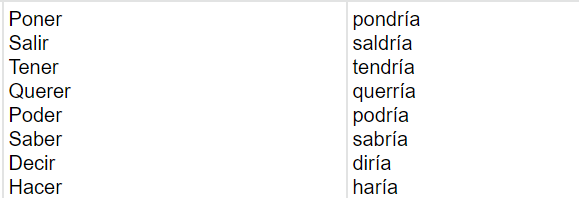
| poner (would/probable past) | pondría |
| tener | tendría / would have |
| salir | saldría / would leave |
| poder | podría / could |
| saber | sabría / would know |
| querer | querría / would want |
| decir | diría / would tell |
| hacer | haría / would do |
| I would tell them that it’s impossible to do it. | Les diría que es imposible hacerlo. |
| When they say the same thing again, I’d leave. | Cuando dicen la misma cosa otra vez, yo saldría. |
| I would want to go, because it’s free. | Querría ir, porque es gratis. |
| I would have it, but Alicia took it. | Lo tendría, pero Alicia lo LLEVÓ. |
| I wonder if he wanted it. | ¿Lo querría? |
| I will see her tomorrow. | La veré mañana. |
| Will you be here? | ¿Estarás aquí? |
| It will be 5:00. | Será las cinco. |
| We will study. | Estudiaremos. |
| Will you all be here? | ¿Estarán aquí? |
| poner (future) | pondrá |
| salir | saldrá |
| tener | tendrá |
| poder | podrá |
| saber | sabrá |
| querer | querrá |
| decir | dirá |
| hacer | hará |
| I will always love you | Te amaré siempre |
| I will always love you | Te querré siempre |
| Will you learn it? | ¿Lo aprenderás? |
| Will they marry? | ¿Se casarán? // What about él, ella, usted and ellos, ellas, ustedes ? You’ll want to use a se with these persons. // se for passive |
| They’re probably enjoying themselves. | Se divertirán. |
| We’ll do it Thursday. | Lo haremos el jueves. |
| I’ll write to them. | Les escribiré. |